DUAL GNSS / INS
VN-300
The VN-300 is a miniature, high-performance Dual Antenna GNSS-Aided Inertial Navigation System that combines MEMS inertial sensors, two high-sensitivity GNSS receivers, and advanced Kalman filtering algorithms to provide optimal estimates of position, velocity, and orientation. By utilizing two separate GNSS receivers and antennas, the VN-300 enables accurate heading measurements without reliance on vehicle dynamics or magnetic sensors, providing unmatched performance under both static and dynamic conditions.
0.15° - 0.3°
GNSS-Compass Heading (1m)
0.2°
Dynamic Heading
0.03°
Dynamic Pitch/Roll
VN-300
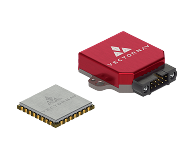
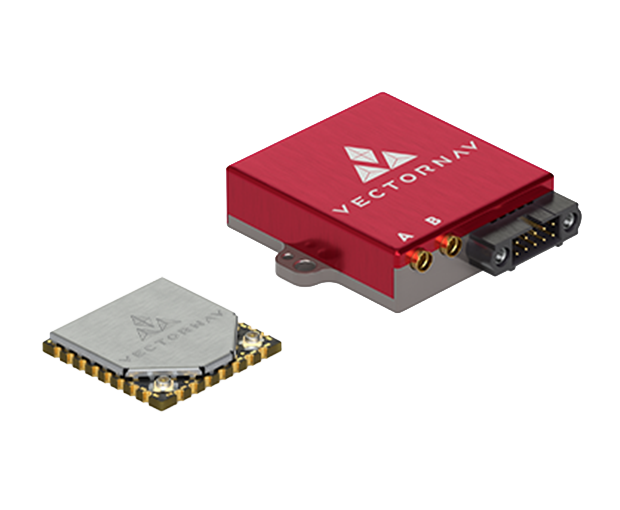
The VN-300 is designed for applications that require highly accurate inertial navigation solution under both static and dynamic operating conditions, especially in environments with unreliable magnetic heading and good GNSS visibility. The VN-300 is the first and only Dual GNSS Antenna Inertial Navigation System in a single surface mount package. At the size of a postage stamp, the VN-300 SMD requires only a single 3.2-5.5V power supply, and can be directly embedded into a user’s electronics for unprecedented SWAP advantages.
The VN-300 Rugged is the “plug and play” version of the VN-300 SMD. Enclosed in a clamshell precision anodized aluminum enclosure, the VN-300 Rugged offers additional protection of the internal MEMs sensors, GNSS receivers and electronics. Interfacing with the module is made through a locking 10-pin connector, as well as two MMCX connectors for external active GPS antennas.
Integrated GNSS Compass
For highly accurate heading in static and low dynamic conditions
User Configurable Messages
ASCII, NMEA-0183 & VectorNav Binary messages
INS Filter
Coupled position, velocity and attitude data for optimal dynamic performance.
Ease of Availability
Made in the USA, ITAR-free, & ships within 1 business day
Field Proven
Released in 2014, tens of thousands of units fielded
High Data Outputs
400 Hz Navigation data; 400 Hz IMU data
Ultra Low SWaP
< 21.8 cm3; < 30 grams; < 1.5 W
Specifications
ATTITUDE
Range (Heading/Yaw, Roll)
± 180°Range (Pitch)
± 90°Heading (Magnetic)*1
2.0° RMSHeading (INS)*2
0.2°, 1σHeading (GNSS-Compass, 1m Baseline)
0.3° RMSPitch/Roll (Static)
0.5° RMSPitch/Roll (INS)*2
0.03°, 1σHeading Mounting Misalignment (Rugged)*3
0.15°, 1σPitch/Roll Mounting Misalignment*3
<0.1°, 1σAngular Resolution
0.001°POSITION/VELOCITY
Horizontal Position Accuracy*4
1.0 m RMSVertical Position Accuracy*4
1.5 m RMSFree Inertial Position Drift*5
3.0 cm/s2Velocity Accuracy
< 0.05 m/s*2With sufficient motion for dynamic alignment.
*3Constant on a per part basis. Can be calibrated out during system integration using boresighting or other alignment processes.
*4With SBAS, clear view of GNSS satellites, good multipath environment, compatible GNSS antenna, and as measured over a 24 hour period.
*5Typical rate of growth in error of position estimates after loss of GNSS signal, provided INS full alignment prior to loss.
Range
±16 gIn-Run Bias Stability
< 0.04 mgNoise Density
0.14 mg/√HzBandwidth
230 HzCross-Axis Sensitivity
±0.05°Range
±2,000°/sIn-Run Bias Stability
< 10°/hr (5°/hr typ.)Noise Density
0.0035°/s /√HzBandwidth
265 HzCross-Axis Sensitivity
< 0.05°Range
±2.5 GaussIn-Run Bias Stability
-Noise Density
140 μGauss/√HzSample Rate
200 HzCross-Axis Sensitivity
±0.05 °Range
10 to 1200 mbarIn-Run Bias Stability
-Accuracy
±1.5 mbarNoise Density
-Sample Rate
250 HzCross-Axis Sensitivity
-Receiver Type
(2) 72 Channel, L1 GNSSSolution Update Rate
5 HzTime-to-First-Fix (Cold)
29 sTime-to-First-Fix (Hot)
1 sAltitude Limit
50,000 mVelocity Limit
500 m/sSurface Mount Device
Size
24 x 22 x 3 mmWeight
5 gInterface Connector
30-pin LGAGNSS Connector
U.FLRugged
Size
45 x 44 x 11 mmWeight
30 gInterface Connector
10-pin HarwinGNSS Connector
MMCXSurface Mount Device
Input Voltage
3.2 to 5.5 VCurrent Draw*1
185mA @ 3.3 VPower*1
< 1.25 WDigital Interface
Serial TTL, SPIBaud Rate
Up to 921,600GNSS PPS
30ns RMS, 60 ns 99%Input
Sync-InOutput
Sync-OutRugged
Input Voltage
3.3 to 14 VCurrent Draw*1
150mA @ 5 VPower*1
1.25 WDigital Interface
Serial TTL, RS-232Baud Rate
Up to 921,600GNSS PPS
30ns RMS, 60 ns 99%Input
Sync-InOutput
Sync-OutOperating Temperature
-40° to +85° CStorage Temperature
-40° to +85° CMTBF (Rugged)
> 125,000 hoursMTBF (SMD)
> 165,000 hoursPackaging Options
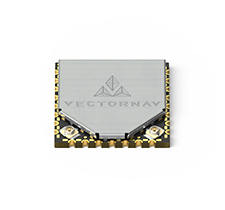
SMD
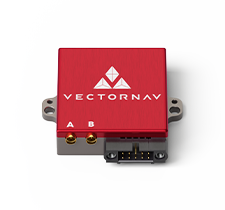
Rugged
Sensor Summary
GNSS Compass for static and low dynamic heading accuracy
VectorNav Processing Engine (VPE) 2.0 for disturbance rejection, adaptive filtering, dynamic filter tuning
Hard/Soft Iron Compensation
Coupled position, velocity and attitude estimates
Solid-State MEMS inertial sensors
All sensors are individually calibrated for bias, scale factor, misalignment, and temperature over full operating range (-40° C to 85° C)
Two x 72 Channel GNSS Receivers:
GPS L1 C/A
Galileo E1
SBAS: L1 C/A
Raw Psuedorange, Doppler and carrier phase outputs
400 Hz IMU Data
400 Hz navigation and attitude data
Yaw/Pitch/Roll
Position and Velocity
Coning and sculling integrals (ΔV’s, Δθ’s)
Data output format: ASCII (VectorNav), NMEA-0183, Binary (VectorNav)
VectorNav Control Center freely available for easy setup, configuration and logging
ITAR-Free
Development Kits
VectorNav development kits are built to move fast. Each kit includes the core hardware and interfaces needed to power up quickly, integrate with your system, and validate performance early. Designed for efficient lab and field evaluation, they reduce setup time and integration risk—helping teams confirm fit, functionality, and performance before committing to full deployment.
REQUEST A DEV KIT