What Is GNSS Compassing?
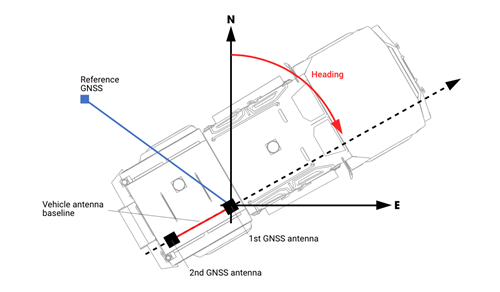
GNSS compassing uses two GNSS antennas mounted at a known separation (baseline) to determine true heading from carrier-phase measurements. By comparing the phase of satellite signals received at each antenna, the system resolves heading with high accuracy and no dependence on the Earth’s magnetic field. This makes GNSS compassing immune to the magnetic distortions that degrade magnetometer-based heading—a persistent challenge on steel-hulled vessels, armored vehicles, and platforms with significant electromagnetic interference.
Unlike magnetometer-based heading, which requires careful calibration to the host platform’s magnetic environment, GNSS compassing delivers true North-referenced heading at any location on Earth without site-specific setup. It also provides reliable heading when the vehicle is stationary or moving slowly, where inertial-only heading estimation accumulates drift.
THE VECTORNAV ADVANTAGE
ACCURATE HEADING ACROSS COMPACT OR EXTENDED BASELINES
VectorNav's dual-antenna carrier-phase processing delivers precise heading across a range of baseline lengths — 0.30°–0.60° RMS at >0.5 m, 0.15°–0.30° RMS at 1.0 m, and 0.08°–0.15° RMS at 2.0 m. With VectorNav, achieve dependable heading performance even in compact, space-limited mechanical layouts. This flexibility supports integration on platforms from compact UAVs to large marine vessels.
TRUE HEADING AT 400Hz
VectorNav’s dual-antenna GNSS compassing delivers precise, drift-free heading at high update rates of 400 Hz, ensuring stable directional awareness under static and low dynamic conditions. Continuous carrier-phase GNSS corrections maintain heading integrity where inertial-only approaches degrade — preserving accuracy for navigation, control, and pointing applications.