What is an AHRS?

An attitude and heading reference system fuses data from accelerometers, gyroscopes, and magnetometers to compute real-time roll, pitch, and heading. Unlike a standalone IMU, which outputs raw inertial measurements that require external processing, an AHRS runs onboard sensor fusion algorithms that deliver orientation data directly, ready for use by flight controllers, stabilization systems, and autonomous platforms.

VectorNav's AHRS is built on the same individually calibrated, temperature-compensated IMU trusted across 120,000 deployed navigation systems, paired with onboard hard and soft iron compensation algorithms refined over nearly two decades. The result is stable, reliable orientation without the recurring manual calibration that other AHRS solutions demand.


WHY VECTORNAV

ACCURATE ATTITUDE & HEADING FOR GUIDANCE, STABILIZATION, AND CONTROL

VectorNav AHRS solutions deliver accurate roll, pitch, and yaw across land, air, and sea applications. With tightly calibrated inertial and magnetic sensors combined through advanced sensor fusion, they provide stable attitude and heading data for guidance, stabilization, and control.

AMM

REAL-TIME HARD & SOFT IRON COMPENSATION

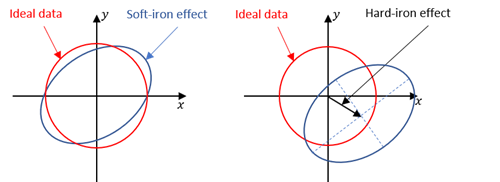
With two decades of development and refinement, VectorNav’s real-time hard and soft iron calibration algorithms continuously model and correct magnetic distortions caused by nearby metal structures and electrical systems. This integrated approach delivers stable heading performance in vehicles, vessels, and airframes where magnetic interference is unavoidable — without the need for recurring manual recalibration.
VELOCITY AIDING FOR DRIFT-FREE ATTITUDE

During sustained accelerations, such as banked turns or rapid maneuvers, a standard AHRS can mistake motion for gravity, causing pitch and roll errors. VectorNav’s velocity aiding incorporates real-time external speed inputs to account for centripetal acceleration and preserve accurate attitude without relying on zero-acceleration assumptions.

READ THE TECHNICAL NOTE

SUPPORT FROM DAY ONE

VectorNav’s applications engineering team provides integration guidance from initial evaluation through field deployment. With units shipping in under one week for Industrial and comprehensive documentation available from day one, the path from purchase to operational capability is fast and fully supported.
AHRS FAQs

Use an AHRS when your system needs real-time orientation (yaw, pitch, and roll) but does not require position or velocity. Common AHRS applications include, camera and gimbal stabilization, platform leveling, heading reference for underwater platforms, indoor platforms and attitude feedback for vehicle control. If your application also requires position and velocity, a GNSS/INS is the better choice.

Heading accuracy depends on the magnetic environment. Industrial-grade (VN-100) and Tactical-grade (VN-110) both deliver 2.0° RMS magnetic heading. For applications requiring sub-degree heading accuracy or operating in magnetically challenging environments, VectorNav's dual-antenna GNSS/INS products (VN-300 / VN-310) provide true heading via GNSS compassing, independent of the magnetic field.

VectorNav's real-time hard and soft iron compensation algorithms continuously model and correct magnetic distortions from nearby metallic structures, motors, and electrical systems. These algorithms have been refined over nearly two decades and operate in real time without requiring recurring manual recalibration — a significant advantage on platforms where the magnetic environment changes with payload configuration or operational state.

During sustained accelerations — banked turns, rapid maneuvers, or launch events — a standard AHRS can mistake motion-induced forces for gravity, causing pitch and roll errors. VectorNav's velocity aiding incorporates real-time external speed inputs (from GNSS, odometry, or airspeed sensors) to distinguish acceleration due to motion from gravitational reference, preserving accurate attitude through dynamics that degrade other AHRS solutions.

Yes. VectorNav's AHRS products (VN-100 / VN-110) share the same hardware platforms and software interfaces as the INS products (VN-200 / VN-210 series). A system designed around a VectorNav AHRS can upgrade to a GNSS/INS with minimal integration changes, protecting your development investment as program requirements evolve.

Industrial-grade (VN-100) achieves 0.5° RMS static pitch and roll accuracy. Tactical-grade (VN-110) achieves 0.05° RMS. Dynamic accuracy depends on the availability of velocity aiding and the severity of the motion environment.

WORK AT VECTORNAV

We're explorers at heart, continually pushing the limits of possible to support out-of-this-world applications and customers. Do you share the desire to discover and define new limits? Learn more about working at VectorNav.